
Ant Control in Springfield is important when ants begin appearing in kitchens, bathrooms, walls, gardens, or around entry points. Although many ants are mainly a nuisance, some species can contaminate food, establish colonies inside buildings, or take advantage of moisture-damaged wood.
Effective ant control starts with identifying the ant species, locating its nesting area, removing conditions that attract it, and choosing an appropriate treatment strategy. Virginia Cooperative Extension’s current 2026 Pest Management Guide provides updated pest-management information for homes and outdoor areas in Virginia.
For homeowners and businesses in Springfield, understanding why ants enter properties can make prevention and professional pest management more effective.
Why Ants Enter Homes in Springfield
Ants commonly enter buildings while searching for food, water, shelter, or suitable nesting conditions. Small gaps around doors, windows, foundations, utility penetrations, and other openings can provide convenient entry routes.
Inside a property, ants may be attracted to:
- Food crumbs and sugary substances
- Pet food and improperly stored food
- Moisture around sinks and plumbing
- Leaking pipes or appliances
- Damp or decaying wood
- Overgrown vegetation touching the building
- Cracks and openings around the foundation
- Outdoor nests close to the structure
The EPA recommends an Integrated Pest Management approach that combines prevention, monitoring, identification, sanitation, exclusion, and appropriate pest-control methods rather than relying on pesticides alone.
Common Signs of an Ant Problem
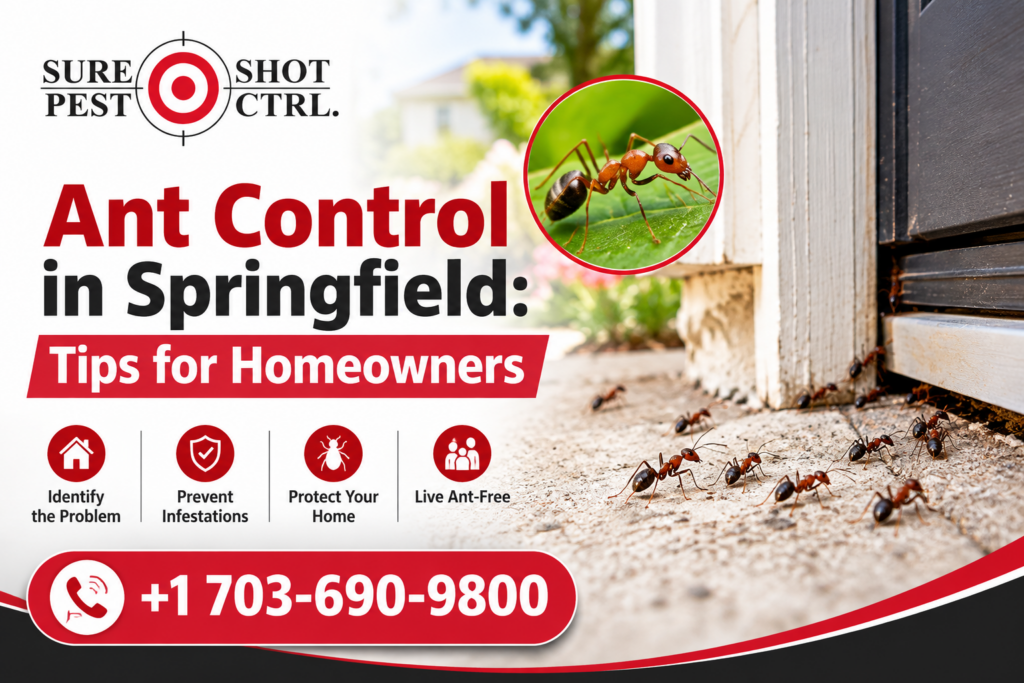
Finding one ant does not necessarily mean there is a major infestation. However, repeated activity can indicate that ants have established a nearby colony or found a reliable food source.
Common signs include:
Visible Ant Trails
Ants often travel along established routes between their nest and food or water sources. Following these trails can sometimes help identify where ants are entering.
Ants Around Food
Repeated activity around countertops, cabinets, garbage containers, pet food, or pantry items may indicate that ants have discovered an indoor food source.
Winged Ants Indoors
Winged ants appearing inside a building can be an important warning sign. Depending on the species and circumstances, they may indicate a nest within the structure.
Sawdust-Like Material
Some ants, particularly carpenter ants, excavate wood for nesting. Small piles of debris or sawdust-like material around wooden areas can warrant further inspection.
Ant Activity Around Moisture
Moisture-damaged wood, plumbing areas, gutters, and damp locations can create favorable conditions for certain ants. Virginia Tech notes that acrobat ants, for example, frequently use previously water-damaged materials as nesting locations.
Ant Control in Springfield: Why Identification Matters
Not every ant problem should be treated in the same way. Different species can have different nesting habits, food preferences, and responses to treatment.
For example, some ants nest outdoors and enter buildings only while foraging. Others may establish colonies in wall voids, insulation, soil, landscaping materials, or moisture-damaged wood.
Virginia Cooperative Extension recommends identifying the ant before selecting a control strategy because species can respond differently to baits and other treatments.
This is why a professional ant inspection can be more useful than simply spraying visible ants.
How Professional Ant Control Works
A professional Ant Control Company typically begins with an inspection rather than immediately applying a treatment.
The process may include:
1. Property Inspection
A technician examines areas where ants are active, including kitchens, bathrooms, foundations, windows, doors, utility entry points, landscaping, moisture-prone areas, and potential nesting locations.
2. Ant Identification
Identifying the type of ant helps determine where the colony may be located and which management approach is appropriate.
3. Locating Entry Points
The inspection looks for cracks, gaps, damaged seals, vegetation touching the structure, and other routes ants may use to enter.
4. Locating the Colony
Whenever possible, the goal is to determine where the ants are nesting. Simply killing visible worker ants may not eliminate the colony.
5. Treatment and Monitoring
Depending on the situation, treatment may involve targeted baiting, exterior applications, exclusion measures, sanitation improvements, or other methods appropriate for the identified pest.
Virginia Tech’s current guidance states that ant control can involve sanitation, perimeter treatments, and species-appropriate baiting, while emphasizing identification and proper application.
Why Spraying Visible Ants May Not Solve the Problem
A common mistake is treating only the ants that can be seen.
Visible ants are often workers searching for food. The colony may be hidden outdoors, beneath landscaping, inside wall voids, or in other protected locations. Eliminating a small number of workers does not necessarily eliminate the nest.
For carpenter ants, for example, extension guidance explains that controlling foraging workers alone may provide only temporary relief because much of the colony remains protected inside the nest.
Effective Ant Control focuses on the source of the activity whenever possible.
How to Prevent Ants from Returning
Good prevention can make a significant difference after treatment.
Keep kitchens and food-storage areas clean, store food in sealed containers, clean spills promptly, and avoid leaving pet food exposed for extended periods.
Outside the property, homeowners can reduce potential entry routes by trimming branches and shrubs away from the building, removing unnecessary debris, addressing moisture problems, and sealing suitable cracks and gaps.
The EPA specifically recommends measures such as storing attractive foods in sealed containers, trimming vegetation away from buildings, fixing leaks, and addressing moisture-damaged wood as part of ant prevention.
Regular inspection is also useful because early detection can make an emerging ant problem easier to manage.
When Should You Call an Ant Control Specialist?
Consider contacting an Ant Control Specialist when ant activity continues despite basic sanitation and exclusion measures, when ants repeatedly appear in multiple rooms, or when you notice signs suggesting an indoor nest.
Professional help is especially worth considering when:
- Ant trails return after cleaning
- Ants appear repeatedly inside walls or ceilings
- Winged ants are found indoors
- Carpenter ants are present around wooden structures
- Ants are coming from difficult-to-reach locations
- Outdoor nests are located close to the building
- DIY treatments provide only temporary relief
A professional inspection can help determine whether the problem is localized or connected to a larger colony.
DIY Ant Control vs. Professional Treatment
DIY methods can sometimes help with minor ant activity, particularly when the attraction is related to accessible food or an obvious entry point.
However, recurring infestations may require more detailed inspection and species identification.
Professional Ant Control can be particularly useful when the nest is hidden, the infestation keeps returning, or the property has moisture and structural conditions that encourage ant activity.
The objective should not simply be to remove visible ants. It should be to understand why they are present and address the conditions supporting the infestation.
Choosing an Ant Control Company in Springfield
When selecting an Ant Control Company, look for a provider that emphasizes inspection, identification, targeted treatment, prevention, and responsible pesticide use.
A quality pest-management approach should explain what was found, where activity is occurring, what treatment is being recommended, and what homeowners or property managers can do to reduce future activity.
Sure Shot Pest focuses on practical pest-management solutions designed around the conditions found at the property. A detailed inspection can help determine the most appropriate approach for the specific ant problem.
FAQs
What is the best way to control ants in a house?
The best approach depends on the ant species and where the colony is located. Effective Ant Control generally combines identification, sanitation, exclusion, moisture management, and targeted treatment. Treating only visible ants may not eliminate a hidden colony.
How can I prevent ants from entering my home?
Keep food sealed, clean spills and crumbs quickly, repair leaks, reduce moisture, trim vegetation away from the building, remove outdoor debris, and seal accessible cracks or gaps. These steps can reduce food, water, shelter, and entry opportunities for ants.
Why do I keep seeing ants after spraying?
Repeated ants may indicate that the colony remains active or that additional ants are entering from another location. Spraying visible workers can reduce activity temporarily without addressing the nest. A professional inspection can help identify the source and determine a more appropriate treatment strategy.
When should I schedule Ant Control in Springfield?
Schedule an inspection when ant activity is frequent, persistent, widespread, or accompanied by winged ants, nesting evidence, or carpenter-ant activity. Early Ant Control in Springfield can help identify the source before the infestation becomes more difficult to manage.
Conclusion: Take Ant Problems Seriously
Ants may start with a few workers around the kitchen or exterior of a property, but repeated activity can indicate a nearby colony or favorable conditions around the building.
Effective Ant Control in Springfield begins with understanding the species, finding potential nesting and entry areas, removing attractants, addressing moisture, and using targeted pest-management methods. Virginia’s 2026 pest-management guidance supports an informed approach based on identification and appropriate control practices.
If ants continue to appear after basic prevention efforts, a professional inspection can help identify the underlying cause.
For professional Ant Control in Springfield, contact Sure Shot Pest to schedule an inspection and discuss the appropriate pest-management solution for your property.