
Introduction
An Ant Control Specialist Company can help homeowners and businesses identify where ants are entering, determine the type of ant involved, and develop a practical plan for controlling the infestation. Seeing a few ants near a kitchen counter may seem minor, but repeated trails can indicate a nearby nest, food source, moisture issue, or entry point.
Ant problems are not always solved by spraying the ants that are visible. Different ant species have different nesting habits and food preferences, so proper inspection and identification are important parts of an effective control program. The University of Minnesota Extension notes that different ant species may respond differently to available baits, while baiting can allow worker ants to carry material back toward the nest.
For homeowners in Springfield, understanding how professional ant control works can make it easier to recognize when DIY methods are no longer enough and when professional assistance from a Specialist Company such as Sure Shot Pest may be appropriate.
What Does an Ant Control Specialist Company Do?
An Ant Control Specialist Company focuses on locating and managing ant activity rather than simply treating the insects that happen to be visible.
A typical service may begin with an inspection of areas where ants are active. The technician may look around kitchens, bathrooms, windows, doors, foundations, utility openings, wall voids, landscaping, and other areas that could provide access to food, water, or shelter.
The purpose of an inspection is to answer several important questions:
- What type of ant is present?
- Where are the ants entering?
- Is there evidence of a nest nearby?
- What food or moisture source is attracting them?
- Are there indoor and outdoor activity points?
- What conditions could allow the infestation to return?
This approach aligns with Integrated Pest Management, or IPM. The U.S. Environmental Protection Agency describes IPM as a pest-management approach that combines monitoring, identification, prevention, and appropriate control methods while considering potential risks.
Why Ant Inspection Matters
A professional Ant Control Specialist does not have to rely only on what can be seen at the time of the visit. Ant trails can provide useful clues about where colonies may be located or where workers are finding resources.
For example, ants repeatedly appearing around a sink could be associated with moisture, food residue, plumbing areas, or an entry point. Ants near windows or exterior walls may indicate access from outdoors.
Inspection can also help distinguish between an isolated occurrence and a continuing infestation.
A useful ant inspection generally considers:
- Visible ant trails and activity.
- Possible nesting locations.
- Cracks and openings around the structure.
- Moisture and plumbing conditions.
- Food and waste sources.
- Vegetation or organic material close to the building.
- Previous pest-control treatments.
Accurate identification is particularly important because ant species do not all behave the same way. Older EPA guidance on ant management also emphasizes identifying the problem ant before selecting a management approach.
Common Reasons Ants Enter Homes in Springfield
Ants generally enter structures because they can find something they need, such as food, water, or shelter.
Common contributing conditions include:
- Food crumbs and spills
- Unsealed food containers
- Pet food left accessible
- Leaking pipes or faucets
- Moisture around sinks
- Cracks around windows and doors
- Gaps around utility lines
- Foundation openings
- Vegetation touching the structure
- Outdoor nesting areas close to the building
The EPA recommends addressing food, water, and shelter conditions as part of broader pest-management practices.
This means homeowners can support professional treatment by keeping food sealed, cleaning spills promptly, managing moisture, repairing obvious openings, and maintaining areas around the exterior of the property.
Ant Control Specialist vs. DIY Ant Treatment
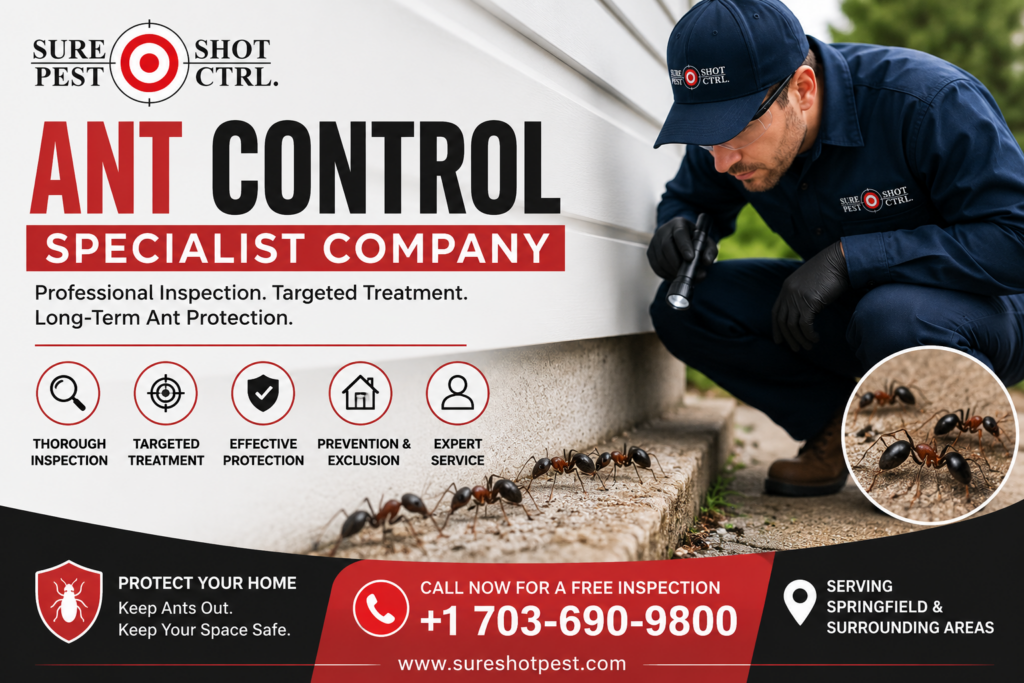
DIY ant products may help with occasional activity, but recurring infestations can be more complicated.
One common mistake is treating only the visible ants. Killing visible workers may reduce activity temporarily without addressing the source.
Ant baits work differently. According to University of Minnesota Extension, workers can carry bait back toward the nest, and bait treatments may take time because they depend on ants consuming and distributing the material.
Spraying insecticide around bait can also interfere with baiting strategies, which is why treatment should follow the product label and the pest-management plan being used.
A professional Ant Control Specialist can assess the situation and determine whether baiting, targeted applications, exclusion, sanitation improvements, monitoring, or a combination of methods is appropriate.
How Professional Ant Control Works
An Ant Control Specialist Company may use an integrated process rather than depending on one treatment method.
1. Inspection and Identification
The process begins by locating activity and identifying, where possible, the ant species or group involved.
2. Source and Entry-Point Assessment
The technician looks for conditions that allow ants to enter or remain around the property. These may include cracks, gaps, moisture, vegetation, or food sources.
3. Targeted Treatment
Depending on the infestation, treatment can involve carefully selected products or methods designed for the specific situation. EPA guidance emphasizes using appropriate pest-management options and selecting less-risky approaches when practical.
4. Monitoring
Ant activity should be observed after treatment rather than assuming that one application automatically solves every infestation.
5. Prevention
Long-term management may include recommendations for sealing entry points, correcting moisture problems, improving sanitation, and reducing conditions that attract ants.
This combination of inspection, treatment, monitoring, and prevention reflects the principles of IPM.
When Should You Call an Ant Control Specialist?
Professional assistance may be worth considering when ants:
- Keep returning after DIY treatment
- Appear in several rooms
- Form visible trails
- Are concentrated around windows, walls, or plumbing
- Continue appearing despite cleaning
- Are coming from wall voids or difficult-to-access locations
- Are affecting a commercial property
- Are difficult to identify
A single ant does not necessarily mean there is a major infestation. However, repeated activity is a useful reason to investigate the underlying conditions.
Choosing an Ant Control Specialist Company in Springfield
When searching for an Ant Control Specialist Company in Springfield, homeowners should look beyond advertising claims and consider how the company approaches pest management.
The EPA advises consumers to choose pest-control companies carefully and notes the importance of licensing and experience with IPM.
Consider asking:
- Does the company inspect before recommending treatment?
- Does it explain what was found?
- Does it identify potential entry points?
- Does it discuss prevention?
- Are treatment products used according to their labels?
- Does the company provide follow-up or monitoring when appropriate?
- Can the company explain what homeowners should do before and after treatment?
Clear communication is an important part of a professional pest-management service.
Why Ant Problems Can Return
Ant control is not always about eliminating every ant outdoors. Ants are part of the surrounding ecosystem, and outdoor activity can continue even after indoor activity has been addressed.
The goal of residential pest management is often to reduce unwanted activity inside the structure and address the conditions that encourage ants to enter.
If food remains accessible, moisture problems continue, or structural openings remain, new ants may find the same route later.
That is why prevention should be considered alongside treatment.
Simple Ant Prevention Tips for Homeowners
Homeowners can reduce conditions that attract ants by taking several practical steps:
- Store food in sealed containers.
- Clean crumbs and food spills quickly.
- Keep kitchen surfaces clean.
- Empty garbage regularly.
- Avoid leaving pet food exposed for long periods.
- Repair leaks and moisture problems.
- Seal visible cracks and gaps where practical.
- Keep vegetation from directly contacting the structure.
- Inspect doors and windows for gaps.
- Monitor recurring ant trails.
These measures do not replace professional treatment when an infestation is established, but they can support a broader pest-management plan.
Why Choose Sure Shot Pest for Ant Control?
Sure Shot Pest provides pest-control services for property owners dealing with unwanted insect activity. When ants repeatedly appear, an inspection can help determine whether the issue is related to an entry point, food source, moisture condition, or nearby nesting activity.
The focus should be on understanding the specific property and pest situation rather than assuming that every ant problem requires the same treatment.
For homeowners searching for an Ant Control Specialist, Ant Control Specialist Company, or ant Inspection service in Springfield, Sure Shot Pest can be considered when professional assessment and pest-management guidance are needed.
FAQ
What does an Ant Control Specialist Company do?
An Ant Control Specialist Company inspects the property, identifies ant activity, looks for entry points and contributing conditions, and recommends appropriate control measures. Depending on the situation, management may include targeted treatment, baiting, monitoring, sanitation improvements, and prevention recommendations.
How does an Ant Control Specialist find an ant infestation?
An Ant Control Specialist looks for ant trails, nesting indicators, entry points, moisture sources, food availability, and activity around indoor and outdoor areas. Identification can help determine which control approach is appropriate because different ant species can have different behaviors and food preferences.
Is an ant inspection necessary before treatment?
An inspection is useful because visible ants do not always reveal the source of an infestation. An Inspection can identify where ants are entering, what conditions are attracting them, and whether activity may be coming from outdoors or concealed areas. This information can help guide a more targeted management approach.
How can I prevent ants from returning?
Keep food sealed, clean spills and crumbs, manage moisture, repair leaks, reduce clutter, and seal accessible cracks and gaps. Exterior maintenance can also help reduce opportunities for ants to enter. If activity continues despite these measures, contacting an Ant Control Specialist Company for an inspection can help identify underlying conditions.
Conclusion: Address Ant Activity at the Source
Ants can become a recurring household problem when food, moisture, shelter, and convenient entry points are available. Simply treating visible ants may not address the conditions that keep bringing them back.
An Ant Control Specialist Company can approach the problem through inspection, identification, targeted control, monitoring, and prevention. For Springfield homeowners and businesses, this approach can provide a clearer understanding of why ants are appearing and what steps can be taken next.
Sure Shot Pest can help property owners evaluate recurring ant activity and determine an appropriate pest-management approach. If you are noticing repeated ant trails or unexplained ant activity, contact Sure Shot Pest to arrange an inspection and discuss your options.